|
34/123 |  |
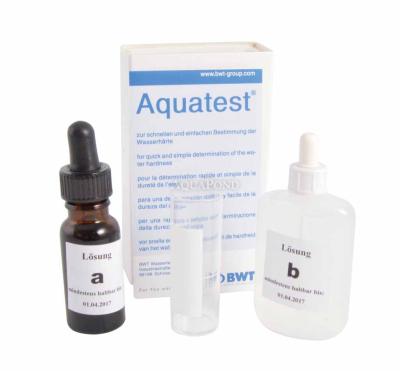
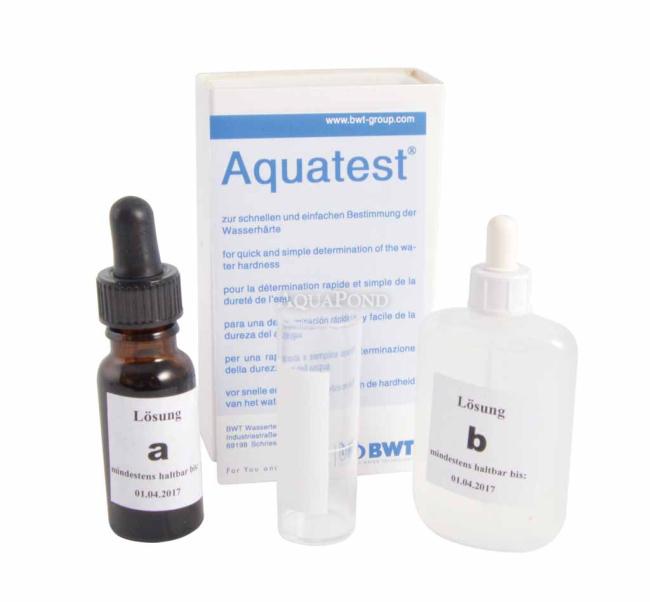
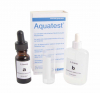
BWT water hardness tester AQUATEST
 |
 |
BWT water hardness tester AQUATEST
Description
Tester for measuring pool water hardness. Read more
-
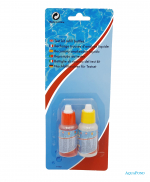
BWT AQUATEST Water Hardness Tester
Water hardness is a property that indicates the content of dissolved minerals (most commonly CaO and MgO) in water. Water hardness is important for its use as both drinking and utility water. It is a source of limescale formation and also affects the taste of water. It can be permanent or temporary. Permanent hardness contains dissolved chlorides, sulfides, nitrates, and silicates. Temporary hardness contains dissolved Ca(HCO3)2 (calcium bicarbonate). When it precipitates, CaCO3 (calcium carbonate) is formed, which is limescale.
Instructions for use
- Before starting the hardness test, let the water run for about 1 minute. Fill the test tube to the white mark.
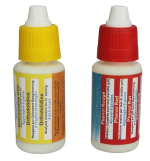
- Add 1–2 drops of test solution A (brown bottle) to the water, shake well, and wait until the solution turns red (light purple).
- Add solution B to the water one drop at a time until the color changes from red to light blue.
- Each drop of solution B corresponds to a hardness of 1 °dH (German degree). If you want to express the final hardness in other units, use the conversion table in the original instructions.
Shake solutions A and B thoroughly before each use!
Residual hardness tester:
- Rinse the test tube with the water being tested and fill it to the 5 ml mark (or 10 ml, if applicable).
- Add 1 (or 2) drops of reagent No. 1 and mix by gently shaking.
- Add reagent No. 2 drop by drop until the liquid changes color from red to light blue (after the last drop, wait about 15 seconds to see whether the color changes).
One drop of reagent No. 2 corresponds to 0.1 °dH for a 5 ml test volume and 0.05 °dH for a 10 ml test. 1.0 °dH = 0.18 mmol/l, 5.6 °dH = 1.0 mmol/l.
-
Related products
Price incl. VAT: 3,00 GBPAvailability:
Price incl. VAT: 3,00 GBPAvailability:
Price incl. VAT: 3,00 GBPAvailability:
Price incl. VAT: 4,00 GBPAvailability:In stock
Price incl. VAT: 9,00 GBPAvailability:
Price incl. VAT: 8,00 GBPAvailability:
Price incl. VAT: 16,00 GBPAvailability:
Price incl. VAT: 8,00 GBPAvailability: